Introduction
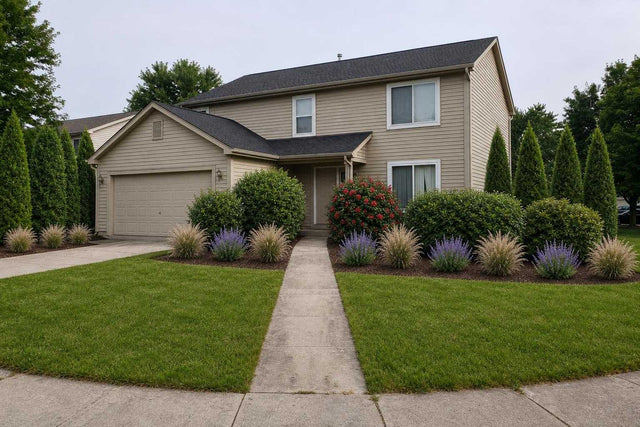
A good-looking front yard doesn't have to mean weekends spent mowing, shearing shrubs and replanting flower beds. Most of the work in a typical front yard comes from a few fixable choices: too much lawn, plants that outgrow their space, and bare soil that invites weeds.
Below are 12 low-maintenance front yard landscaping ideas, the plants that make them work, and a before-and-after from our free design tool, where you can get a low-maintenance planting plan for your zone in a few minutes.
One honest note before we start: "low-maintenance" means less work, not no work. Expect a little watering in the first year and a short cleanup each season. We cover exactly what's left in the yearly calendar near the end.
What Makes a Front Yard Low-Maintenance?
Almost every low-maintenance yard follows the same five rules:
- Choose plants by mature size. If a shrub will fit the space when fully grown, you'll never have to prune it to keep it there.
- Let evergreens do the structural work. They look the same all year and don't need replanting.
- Plant less lawn. Lawn is the highest-maintenance thing in most front yards: weekly mowing, edging, feeding and watering.
- Cover the soil. Groundcover, gravel or mulch keeps weeds from getting a foothold.
- Water deeply, not often. Once established, many shrubs need watering only in long dry spells.
12 Low-Maintenance Front Yard Landscaping Ideas
1. Shrink the lawn with a wide planting border
The single biggest time-saver is replacing part of the lawn with planting beds. Turn the strip along the house, or a wide curve across the front of the yard, into a deep border 8 to 10 feet wide. Keep a smaller patch of lawn in the middle if you like the look.

A wide border replaces most of the lawn, leaving a small oval of grass that takes minutes to mow.
Less lawn means less mowing, edging and watering. A well-planted border, once it fills in, needs only a seasonal tidy-up.
2. Use dwarf evergreens that keep their shape
Sheared boxes and balls look neat for a few weeks, then need clipping again. Dwarf evergreens grow slowly into naturally rounded, conical or spreading shapes, so you can leave them alone.

Dwarf evergreens left in their natural shapes, spaced so they never touch the house.
Good choices include Wintergreen Boxwood, Dwarf Burford Holly, Hetz Midget Arborvitae and the spreading Sea Green Juniper. Browse our evergreens for small yards for more compact options.
3. Pick plants that fit the space at full size
Most pruning happens because a plant was too big for its spot. Before you buy, check the mature height and width on the product page, then plant so each shrub has that much room. For foundation beds, keep shrubs at least half their mature width from the wall, and choose plants that will stay below window sills under windows.
Your beds will look a little sparse for the first year or two. That's normal, and far less work than digging out an overgrown shrub later.
4. Plant drought-tolerant shrubs and perennials
Once their roots are established (usually after the first growing season), drought-tolerant plants need watering only in extended dry spells. That cuts one of the most time-consuming summer chores.

Russian sage, pink muhly grass and creeping juniper in gravel: a bed that thrives on sun and little water.
Proven performers: Russian Sage, Pink Muhly Grass, Blue Point Juniper and, in warm climates, Green Cloud Texas Sage. See all our drought-tolerant plants.
5. Fill gaps with groundcover instead of re-mulching
Bare mulch breaks down and needs topping up every year. A living groundcover fills the space between shrubs, shades out weeds and stays put. You'll still mulch while it fills in, usually for one or two seasons, but after that it does the job for you.
For sun, try Blue Pacific Shore Juniper or Creeping Rosemary. For shade, Mondo Grass forms a neat, low carpet. Browse all our ground covers.
6. Use gravel or river rock around tough plants
Rock doesn't decompose, blow away or need replacing, which makes it one of the lowest-maintenance surfaces you can use. It works best around drought-tolerant shrubs and grasses, and with a few boulders it looks intentional rather than bare.

River rock, grouped boulders and a few tough plants make a bed that barely changes from year to year.
Lay landscape fabric or a thick layer of cardboard underneath to keep weeds down, and leave enough plants in the bed (roughly half coverage) so it doesn't feel like a parking lot. Rock holds heat, so pair it with sun-loving plants rather than shade plants.
7. Repeat a few plants instead of planting many
A border of three plants repeated in groups looks more designed than one with fifteen different shrubs, and it's easier to care for. Every plant in the group needs the same treatment at the same time.

Just three plants, repeated: boxwood, low shrub roses and liriope.
This exact combination works in much of the U.S.: Green Mountain Boxwood at the back, Coral Drift Rose in the middle and Super Blue Liriope along the edge.
8. Choose reblooming shrubs that don't need deadheading
Traditional roses and many flowering shrubs need spent blooms removed to keep flowering. Self-cleaning varieties drop their old flowers on their own and keep blooming from spring to frost.
Look for landscape roses like Coral Drift, White Drift and White Knock Out, and panicle or smooth hydrangeas like Limelight and Annabelle, which need just one cut each year in late winter.
9. Add ornamental grasses that need one cut a year
Ornamental grasses give a front yard movement and texture with almost no care. Leave them standing through winter for interest, then cut them back to a few inches in late winter before new growth starts. That's the whole maintenance routine.
Compact choices for front beds include Adagio Maiden Grass, Dwarf Fountain Grass and Pink Muhly Grass.
10. Plant natives and regionally adapted plants
Plants that suit your local climate and soil need less water, less fertilizer and less fuss. Check your USDA hardiness zone, which is listed on every Simply Trees product page, and favor plants rated well within your zone rather than at the edge of it. Native plants also support local pollinators and wildlife.
11. Put watering on a timer
A drip line or soaker hose on a simple timer delivers water straight to the roots, wastes less than a sprinkler and removes the need to remember. It's most useful in the first year, while new plants establish.

A steel edge keeps grass out of the bed, and a drip line waters the roots on a timer.
12. Edge your beds cleanly
Lawn grass creeping into planting beds is one of the most common ongoing chores. A physical edge, such as steel, aluminum, stone or a deep spade-cut trench, keeps the grass out and gives the mower a clean line to follow. Install it once and you'll spend far less time weeding the bed margins.
Cheap and Simple Low-Maintenance Front Yard Ideas
Low-maintenance doesn't have to mean expensive. A few ways to keep costs down:
- Buy smaller sizes. One-gallon and three-gallon shrubs cost much less than larger sizes and often catch up within a few seasons.
- Plant in phases. Start with the structure (evergreens and one small tree) this year, then add flowering shrubs and groundcover next year.
- Spend on structure first. A few well-placed evergreens make the biggest visual difference for the money.
- Keep what works. If you have healthy shrubs that fit their space, design around them instead of replacing them.
- Use free materials. Cardboard under mulch works as a weed barrier, and many towns give away wood-chip mulch.
The Best Low-Maintenance Plants for Front Yards
| Type | Plant | Why it's low-maintenance | Sun |
|---|---|---|---|
| Evergreen shrub | Wintergreen Boxwood | Slow-growing, holds a rounded shape without shearing | Sun to part shade |
| Evergreen shrub | Needlepoint Holly | Dense, glossy and tough; red berries in winter | Sun to part shade |
| Evergreen shrub | Dwarf Burford Holly | Compact and heat-tolerant | Sun to part shade |
| Evergreen shrub | Skip Laurel | Fills space quickly, little pruning if given room | Sun to part shade |
| Flowering shrub | Berry White Hydrangea | Blooms on new wood, so one late-winter cut is all it needs | Sun to part sun |
| Flowering shrub | Coral Drift Rose | Self-cleaning, reblooms spring to frost | Full sun |
| Flowering shrub | Little John Dwarf Bottlebrush | Compact evergreen, drought-tolerant once established (warm climates) | Full sun |
| Small tree | Thunderstruck White Lightning Crape Myrtle | Compact crape myrtle that fits a front yard without heavy pruning | Full sun |
| Perennial | Russian Sage | Drought-tolerant, one cut back a year | Full sun |
| Grass | Adagio Maiden Grass | Compact, one cut a year, winter interest | Full sun |
| Groundcover | Blue Pacific Shore Juniper | Spreads flat and blocks weeds | Full sun |
| Groundcover | Mondo Grass | Neat, slow, evergreen carpet | Part shade to shade |
Always check that a plant is rated for your USDA hardiness zone before buying.
Example: A Low-Maintenance Front Yard From Our Design Tool
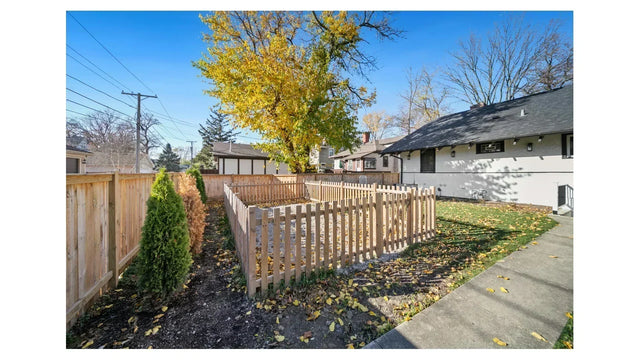
Here's a front yard that takes a lot of work: a patchy lawn full of dandelions, shrubs sheared into boxes, and an empty annual bed beside the walkway that needs replanting every spring.

Before: a lawn that needs constant care, sheared shrubs and a bed that has to be replanted every year.
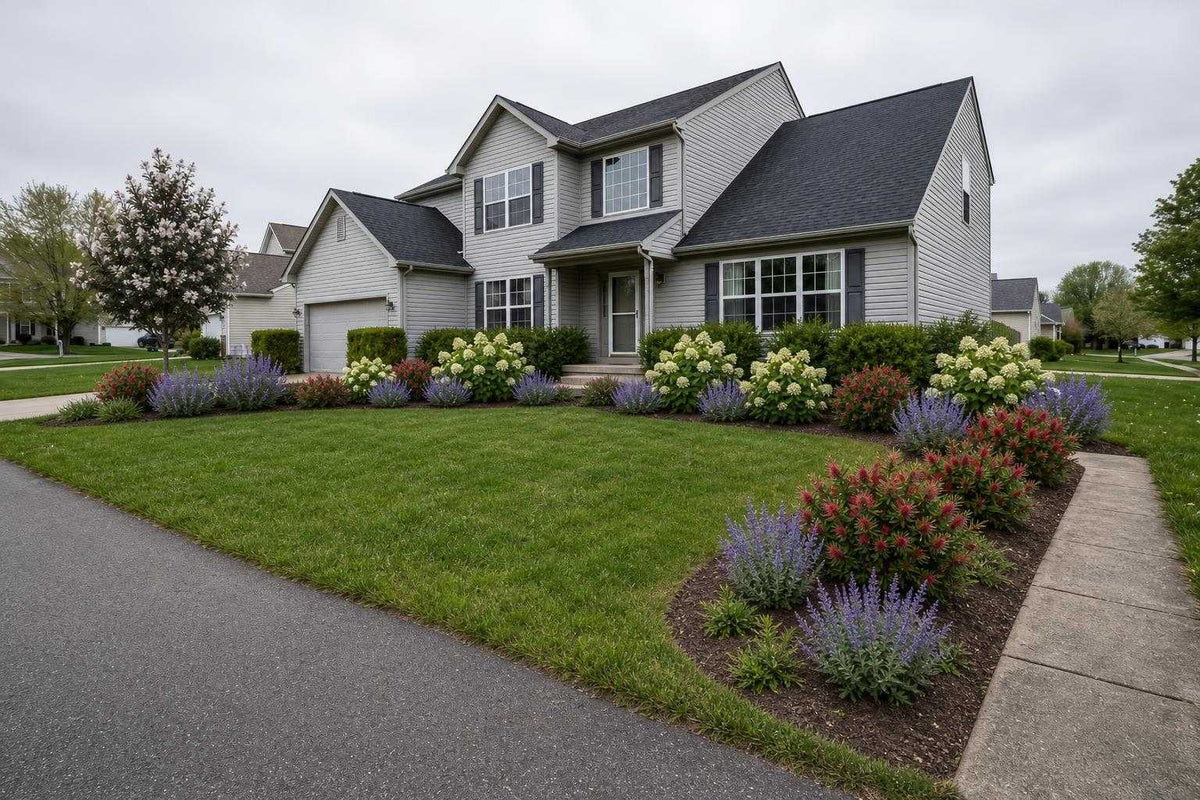
We uploaded the photo to our free landscape design tool and chose a North Texas ZIP code (75494), full sun, a medium-sized yard, low upkeep, a budget of about $1,000 to $2,000, and curb appeal as the goal. It returned this plan:

After: design preview from our free landscape design tool, with plants shown at mature size.
The plan uses five plants, all chosen for low upkeep:
- Thunderstruck White Lightning Crape Myrtle (1): a compact flowering tree to anchor the corner
- Needlepoint Holly (2): evergreen structure with winter berries
- Little John Dwarf Bottlebrush (7): compact evergreen shrubs with red summer flowers
- Berry White Hydrangea (5): big summer blooms with one cut a year
- Russian Sage (11): drought-tolerant color from summer into fall
Notice what the plan leaves out: no sheared hedges, no annual bed to replant, and every plant chosen to fit its spot at mature size. Little John Bottlebrush is a warm-climate shrub (roughly USDA zones 8 to 11), so the tool picked it for this Texas yard. Enter your own ZIP code and it will choose plants suited to your zone instead.
Want the same for your yard? Plan your low-maintenance front yard with the tool. Upload a photo (or skip it), answer a few questions about your ZIP code, sun, space, upkeep, budget and goals, and it builds a planting plan from in-stock plants. You can preview it on your own yard photo and add the whole plan to your cart in one step.
What's Left to Do: A Simple Yearly Maintenance Calendar
Even a low-maintenance front yard needs a little attention. Here's roughly what a year looks like once your plants are established:
| Season | Tasks |
|---|---|
| Late winter | Cut back ornamental grasses, Russian sage and panicle hydrangeas. Remove any dead or damaged branches. |
| Spring | Pull early weeds, top up mulch where groundcover hasn't filled in, and check drip lines. |
| Summer | Water deeply during long dry spells, especially plants in their first year. |
| Fall | Plant new additions (fall is ideal in most regions) and clear fallen leaves from low groundcovers. |
That's a few hours a season, compared with weekly mowing and regular shearing in a traditional front yard.
Low-Maintenance Front Yard FAQ
What is the lowest-maintenance front yard?
One with a small lawn (or none), beds of evergreen shrubs and drought-tolerant perennials chosen to fit their space at full size, and groundcover, gravel or mulch covering all the bare soil. Add a drip line on a timer and the routine drops to a short seasonal cleanup.
What is the easiest shrub to maintain?
Slow-growing evergreens that hold their shape naturally, like boxwood and compact hollies, are among the easiest. For flowers, self-cleaning roses such as Drift and Knock Out and panicle hydrangeas need very little care. The key is choosing one whose mature size fits the spot.
Is rock or mulch better for low maintenance?
Rock lasts for years and never needs topping up, so it's lower-maintenance over time. It also holds heat, which suits drought-tolerant, sun-loving plants. Mulch is better for most shrubs and perennials because it cools the soil and improves it as it breaks down, but it needs refreshing every year or two. Living groundcover eventually replaces both.
How do I make my front yard low-maintenance without grass?
Replace the lawn with planting beds of evergreen shrubs, ornamental grasses and drought-tolerant perennials, cover the soil with groundcover or gravel, and add a path or stepping stones so the space is still usable. Kill the grass first (smothering it with cardboard and mulch works well) rather than digging it all out.
What plants don't need regular watering?
Once established, drought-tolerant plants such as Russian sage, junipers, ornamental grasses like muhly and maiden grass, and warm-climate shrubs like Texas sage need water only during extended dry spells. Every new plant needs regular watering in its first growing season while its roots establish.
Start Your Low-Maintenance Front Yard
The formula is simple: less lawn, plants that fit their space, evergreens for structure, and nothing left as bare soil. For more design ideas, see our guide to front yard landscaping ideas.
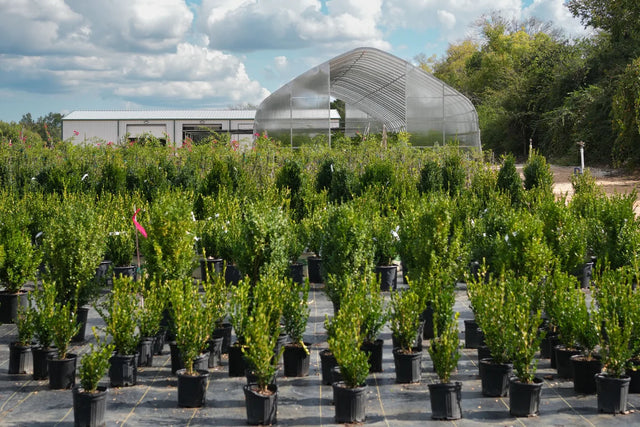
Browse our drought-tolerant plants, evergreens for small yards and ground covers, all container-grown and shipped from our farm in Winnsboro, Texas. Or let our free design tool pick the plants for you.