Introduction
Most front yards start the same way: a strip of lawn, a couple of overgrown shrubs by the door, and a bare foundation that looks the same in January as it does in June. The good news is that turning that into a front yard people slow down to look at doesn't take a big budget or a landscape architect. It takes a plan with a few layers that each do a specific job.
Below you'll find 10 front yard landscaping ideas you can copy, the simple six-layer formula behind every good planting bed, and before-and-after design previews from our free landscape design tool, so you can see exactly what changes and why.
10 Front Yard Landscaping Ideas
1. Frame the front door with a matching pair
Two identical evergreens on either side of the entry are the fastest way to make a front door look intentional. Round shapes feel classic; columnar shapes feel modern. Containers work well if you have a stoop or no planting space.

Container boxwoods frame the entry, with seasonal annuals at their feet.
Good choices: Wintergreen Boxwood or Green Mountain Boxwood for rounded shapes, or columnar trees like the Taylor Juniper or Sky Pencil Holly for a narrow, vertical look.
2. Layer the foundation bed: tall, middle, low
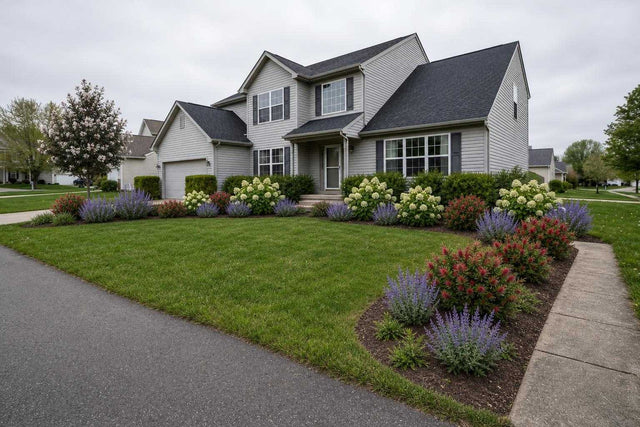
The bed along the front of the house works best in three rows: tall evergreens at the back, flowering shrubs in the middle, and low groundcover at the front edge. It hides the foundation, adds depth, and gives you color without losing structure.

Three layers: arborvitae at the back, hydrangeas in the middle, groundcover in front.
One tip from this picture: keep tall evergreens between windows, not in front of them. Plant them at least 3 to 4 feet out from the wall so air can move and you can reach the house for maintenance. Try Emerald Green Arborvitae or Spartan Juniper for the back row and Endless Summer BloomStruck Hydrangea or Limelight Hydrangea for the middle.
3. Anchor a corner with one ornamental tree
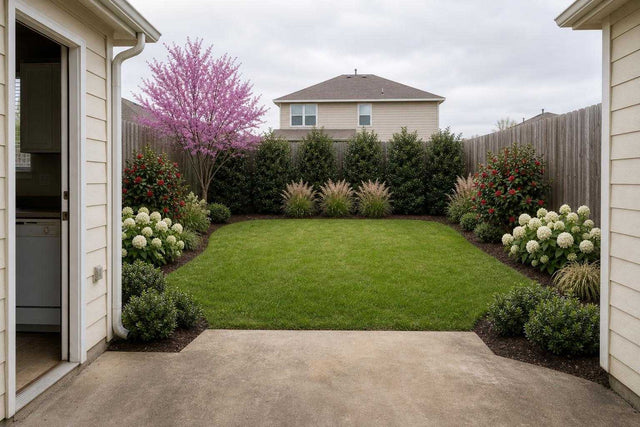
A single mid-sized flowering or ornamental tree off the corner of the house softens the roofline and gives the whole yard depth. One tree is usually enough; it becomes the focal point everything else is arranged around.

A redbud planted out from the corner, in its own curved bed.
Placement matters more than variety. Plant small trees at least half their mature width away from the house; for most ornamental trees that's roughly 8 to 15 feet. Too close and the canopy ends up pressed against your siding. Good options include the Eastern Redbud, Bloodgood Japanese Maple, and, in warmer zones, Natchez Crape Myrtle. For more options, see our guide to the best small trees for the front yard.
4. Swap straight bed lines for curves
Straight beds that run parallel to the house make a yard feel narrow. A wide, sweeping curve draws the eye across the lawn, makes mowing easier, and gives you deeper planting pockets at the corners.

A sweeping curved edge, with groundcover filling the bed instead of bare mulch.
To mark out a curve, lay a garden hose on the lawn and adjust it until it looks right from the street and from your front door, then cut along it.
5. Line the walkway with evergreens and rebloomers
The path to your door is the part of the yard every visitor actually walks through. Edge it with low evergreens for structure and tuck reblooming shrubs behind them for color that lasts from spring to frost.

Boxwood structure along the path, with reblooming roses behind.
Pair boxwoods with reblooming roses like the Double Knock Out Rose or Coral Drift Rose. Keep plants far enough back from the edge that they won't spill onto the path at full size.
6. Turn the mailbox into a mini garden
The mailbox is the first thing people see from the street, and a small bed around it ties the curb to the rest of the yard. Use one small evergreen for year-round shape and fill around it with annuals you can change each season.

A dwarf evergreen for structure, with annuals for seasonal color.
Keep it low and compact so it doesn't block the mail carrier or sight lines from the driveway. A compact conifer like Baby Blue Spruce or a mounding shrub works well as the centerpiece.
7. Plan for winter, not just spring
Most front yards look their best in May and their worst in January. Add one or two plants that peak in the cold months: fall and winter bloomers, or shrubs with winter berries. Put them where you'll see them most, like by the front door.

A red-blooming camellia and a berried holly keep the entry bright after everything else has gone dormant.
The Yuletide Camellia in the design preview further down this page blooms red from late fall into winter. Hollies like Nellie Stevens Holly and Dwarf Burford Holly add glossy evergreen leaves and red winter berries.
8. Use groundcover instead of endless mulch
Bare mulch needs topping up every year and still lets weeds through. A living groundcover fills the gaps between shrubs, shades out weeds and makes a bed look finished. You'll still mulch new beds while the groundcover fills in, usually over one to two seasons, but after that it does the work for you.

Creeping juniper fills the gaps between boxwoods, so there's almost no bare mulch to maintain.
For sun, try Blue Rug Juniper or Creeping Rosemary. For shade, Mondo Grass forms a neat, low carpet. Browse all our ground covers to compare.
9. Add movement with ornamental grasses
Evergreens and shrubs give a yard structure, but grasses give it life. They sway in the breeze, catch the evening light and, in many cases, hold their plumes through winter. Plant them in groups of three or five for the best effect.

Ornamental grasses, pink muhly and Russian sage catch the late-afternoon light in fall.
Adagio Maiden Grass stays compact for front beds, Pink Muhly Grass turns into a pink haze in fall, and Russian Sage adds a soft, airy blue alongside them. Many of these are also drought-tolerant and pollinator-friendly.
10. Work with shade, not against it
If mature trees shade your front yard, stop fighting for grass. A shade bed of hostas, ferns, heuchera and shade-tolerant shrubs under the canopy will look lush where lawn struggles.

Hostas, ferns and heuchera thrive where grass won't grow under mature trees.
When planting under trees, add plants in small pockets between roots rather than piling soil over the root zone, and skip climbing vines on the trunk. Hydrangeas like Annabelle handle part shade well, and Mondo Grass makes a tidy edge.
The Formula Behind a Front Yard That Looks Good All Year
Every idea above comes back to the same six layers. Get these right and your front yard will look planned in every season, not just spring.
| Layer | Its job | Plants to try |
|---|---|---|
| 1. Evergreen shrubs | The "bones": shape and structure all year | Skip Laurel, Wintergreen Boxwood, Emerald Green Arborvitae |
| 2. Winter interest | Keeps the yard alive from November to February | Yuletide Camellia, Nellie Stevens Holly, Dwarf Burford Holly |
| 3. One or a few ornamental trees | Height, depth and a focal point | Eastern Redbud, Bloodgood Japanese Maple, Natchez Crape Myrtle |
| 4. Reblooming shrubs | Main color from spring to fall, with little replanting | BloomStruck Hydrangea, Limelight Hydrangea, Double Knock Out Rose |
| 5. Groundcover | Fills gaps, suppresses weeds, looks finished | Blue Rug Juniper, Mondo Grass, Creeping Rosemary |
| 6. Seasonal color | The easy-to-change accent layer | Annuals, bulbs, Russian Sage, Star Jasmine |
You don't need every layer in every bed. A small front yard might use only structure, one rebloomer and groundcover. But if your yard looks flat or empty half the year, check which layer is missing. It's usually winter interest or groundcover.
Front Garden Design Basics
A few principles make any of these ideas work better:
- Plan for mature size. Space plants for how big they'll be in five years, not how big they are on delivery day. A gappy bed fills in; an overcrowded one has to be dug up.
- Plant in odd numbers. Groups of three, five or seven look natural; pairs are best saved for formal moments like framing the door.
- Repeat plants. Using the same few plants in several places makes a yard feel cohesive. Ten different shrubs in a row reads as random.
- Match plants to your conditions. Check your USDA hardiness zone (it's listed on every Simply Trees product page) and how many hours of sun each bed gets before you choose.
- Balance the house. Use taller plants to soften tall, bare walls and corners, and keep plantings below window sills under windows.
Front Yard Ideas by Situation
Small front yards
Choose dwarf and columnar plants, use one small tree at most, and lean on a single strong bed rather than several small ones. Our evergreens for small yards are sized for tight spaces.
Low-maintenance front yards
Go heavy on evergreens and groundcover, choose reblooming shrubs that don't need deadheading, and add drought-tolerant plants so you water less once they're established. Native plants adapted to your region need the least care of all.
Front yards that need privacy
Use taller evergreens along property lines or between the house and the street. Privacy trees like the Thuja Green Giant grow quickly, and our guide to privacy trees compares the best options. For a softer screen, mix in evergreen privacy shrubs like the Waxleaf Privet.
Shady front yards
See idea #10 above: plant shade-loving perennials and shrubs under the canopy, and let them replace lawn where grass won't grow.
See Your Own Front Yard Redesigned
Here's how the ideas above come together on one yard. Start with a typical suburban front yard: lawn running straight up to the house, two shapeless shrubs crowding the entry, and nothing that says "welcome."

Before: lawn to the foundation and two overgrown shrubs by the door.
We uploaded that photo to our landscape design tool, answered a few questions about the yard, set a budget of $1,500 to $3,000, and it returned this plan:

After: design preview from our free landscape design tool, with plants shown at mature size.
The plan uses just five plants:
- Emerald Green Arborvitae for tall evergreen structure at the corners
- Skip Laurel for rounded evergreen mass across the beds
- Yuletide Camellia by the door, which blooms red from late fall into winter
- Adagio Maiden Grass for movement and texture that stands through winter
- Russian Sage for a long run of summer-to-fall color
Notice what's happening: evergreens hold the shape all year, the camellia covers the season when everything else is quiet, and the grasses and sage bring color and motion in the warm months. That's the six-layer formula in action.
You can do the same with your own yard in our landscape design tool. Upload a photo of your yard (or skip it), answer a few questions about your ZIP code, sun, space and how much upkeep you want, and it builds a planting plan from in-stock plants suited to your growing zone. You can preview the plan on your own yard photo and add the whole plan to your cart in one step.
It's free, and it's the quickest way to go from "I should do something with the front yard" to an actual plan. Get a planting plan for your front yard.
Front Yard Landscaping FAQ
What is the 3-5-7 rule in landscaping?
It's a guideline to plant in odd-numbered groups of three, five or seven. Odd numbers look more natural than even ones, which tend to read as rows. Save pairs for formal, symmetrical spots like either side of the front door.
What is the cheapest way to landscape a front yard?
Spend on structure first: a few evergreen shrubs and one ornamental tree make the biggest visual difference for the money. Buy smaller sizes and let them grow in, reshape existing beds with curved edges, and fill in with groundcover and a handful of annuals rather than lots of large plants.
What are good low-maintenance shrubs for a front yard?
Evergreens that hold their shape without much pruning, like boxwood, Skip Laurel, hollies and columnar junipers, plus reblooming shrubs like Knock Out roses and Endless Summer hydrangeas. Always check that the shrub's mature size fits the space.
How far from the house should I plant a tree?
As a rule of thumb, plant at least half the tree's mature width away from the house. For most small ornamental trees, that's about 8 to 15 feet. Larger shade trees need considerably more room.
What are common front yard landscaping mistakes?
Planting too close to the house, choosing plants by their nursery size rather than their mature size, blocking windows with tall shrubs, using too many different plants, and planning only for spring color so the yard looks bare in winter.
When is the best time to plant a front yard?
Fall and early spring are ideal in most of the U.S. Cooler temperatures and more reliable rain help new plants root in before summer heat. Container-grown plants can be planted through much of the growing season with regular watering.
Bring Your Front Yard Plan to Life with Simply Trees
Whether you're starting from bare lawn or refreshing a tired foundation bed, the formula is the same: structure first, then winter interest, a focal tree, rebloomers, groundcover and a touch of seasonal color.
Browse our flowering shrubs, flowering trees and low-maintenance evergreens, all container-grown and shipped from our farm in Winnsboro, Texas, straight to your door. Or let our free design tool pick the plants for you.