


Bay Laurel Shrub
Zones 8–11 outdoors; can be grown in Zones 4–7 in containers with winter protection
Buy more, save more
Save up to $1,000 on your whole cart.
Discounts don't stack. At checkout you automatically get whichever saves you more.
See all savings tiers
Your code will auto-apply at checkout.
From our farm to your front door
- Shipped in its nursery pot, so the roots stay undisturbed
- Soil secured so it stays put in transit
- Packed so the plant stays steady on the way to you
At a glance
- Leaves
- Evergreen: keeps its leaves all year
- Sunlight
- Full Sun, Partial Sun, Partial Shade
- Water
- When the top 2" of soil is dry
- Growth & size
- Slow to moderate growth rate; reaches 4–8 ft tall and 4–6 ft wide when grown as a shrub (can grow taller if left unpruned or trained into tree form)
- Botanical name
- Laurus nobilis
- Hardiness
- Zones 8–11 outdoors; can be grown in Zones 4–7 in containers with winter protection
- Tolerates
- Heat tolerantDrought tolerantCoastal tolerant
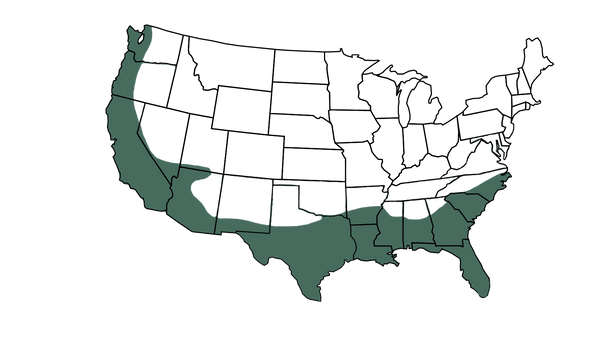
Where it grows in the groundShaded areas are the zones where it can be planted outdoors.


Size guide & what arrives
| *Trade size | **Pot size |
|---|---|
| 1 gallon | 6" |
| 3 gallon | 8 to 10" |
| 5 gallon | 10 to 12" |
| 7 gallon | 14" |
| 10 gallon | 15 to 17" |
| 15 gallon | 17" |
| "Jumbo" | 7 or 10 or 15 gallon |
*Nursery gallon sizes are trade sizes and do not equal standard liquid gallons.
**Pot sizes in inches refer to container width (diameter), not plant or pot height.
Please note: Sizing can differ between plant varieties and growers. Please chat with us if you need clarification.
For more information on sizing, please see our sizing guide.
What arrives
Bay Laurel grows slowly, especially when kept in containers. While it’s an excellent long-term addition to edible or ornamental gardens, it may take time to fill out or produce leaves in quantities large enough for regular harvesting. Customers looking for a mature, full shrub should plan for gradual growth over several seasons.
What customers are saying
Why customers love it

Healthy, well-rooted plants
Hand-selected and shipped in its nursery pot.

Delivered to your door
Skip the nursery trip. Very little car Tetris required.

Goodbye, noisy neighbors
A living screen that blocks the view, softens the sound and looks better than a fence.

1-year guarantee
If something goes wrong, we'll help make it right.
Care made simple
Plant it right once and it does the rest.
Pick the spot before you dig.
Water slowly and deeply. Check more often in its first summer.
Enter your ZIP above to check your zone.
Your first year together
- 1Day 1
Plant it, then water slowly until the whole root ball is soaked.
- 2First few weeks
Keep the soil evenly moist while new roots settle in.
- 3First summer
Water deeply during hot, dry spells.
- 4Next spring
New growth starts. Feed as it wakes up.
Planting instructions
Watering & sunlight
Care guide
Shipping & what's inside
Your plant ships in its nursery pot with the soil secured, packed so it stays steady on the way to you.
1-year guarantee
Every plant is covered by our 1-year guarantee. If something goes wrong, contact our team and we'll walk you through it.
 Answered by Simply Trees plant experts
How big does the Bay Laurel Shrub get?
How fast does the Bay Laurel Shrub grow?
Where is the best place to plant the Bay Laurel Shrub?
How far apart should I plant Bay Laurel Shrubs for privacy?
How do I plant a Bay Laurel Shrub in a container?
1. Choose a pot at least 16–20 inches wide and deep, with drainage holes.
2. Use well-draining soil, such as a mix formulated for shrubs or Mediterranean herbs.
3. Position the container in a sunny location, receiving 4–6+ hours of direct light.
4. Water when the top inch of soil feels dry—avoid waterlogging.
5. Repot every 2–3 years or when the plant becomes root-bound.
Container growing is ideal for cold climates or small spaces, and it makes harvesting leaves easy.
How do I care for a Bay Laurel Shrub?
• Sunlight: Full sun to partial shade (at least 4 hours daily)
• Watering: Water when the top inch of soil is dry; avoid overwatering
• Soil: Well-draining soil; amend clay soils to improve drainage
• Fertilizing: Feed in spring with a balanced, slow-release fertilizer
• Pruning: Lightly shape in early spring or late summer to maintain form
• Winter care: In colder climates, move potted plants indoors before the first frost
This evergreen shrub is drought-tolerant once established and can be pruned to suit both formal or naturalistic garden designs.
When does the Bay Laurel Shrub bloom?
When can I harvest leaves from the Bay Laurel Shrub?
Is the Bay Laurel Shrub evergreen?
Do I need to prune the Bay Laurel Shrub?
• Encourages dense, bushy growth
• Helps maintain your desired shape or size
• Removes dead, damaged, or overly long stems
Prune in early spring before new growth begins, or lightly shape in late summer after the growing season. For topiary or hedge forms, more frequent trimming may be needed throughout the season.